
CaIFF Webinar: Pascal Bertsch
Plant proteins for interfacial stabilization: What we know, what we don’t know
Abstract
The food industry is under heavy pressure to reduce its dependence on animal-based proteins as functional ingredients and transition towards more sustainable plant-based proteins.
The interfacial stabilization of emulsions and foams is one area where the food industry currently heavily relies on animal-based emulsifiers. However, there is currently an immense knowledge gap between animal-based proteins that have been investigated for decades and emerging plant proteins. In this presentation, I will point out some of the most pressing knowledge gaps and propose how we can efficiently fill them by establishing systematic structure-function relationships for plant protein interfacial stabilization.
I will provide an overview of our previous research on protein interfacial adsorption, specifically, how we found a universal correlation of protein adsorption and oil polarity (Figures A,B),1,2 and how this has led to a novel method (alternate subphase tensiometry, AST) that allows the mapping of novel plant-based proteins.
AST facilitates the mapping of the current data landscape (shown for pea protein in Figures C,D), pinpointing current knowledge gaps, and identifying specifically promising plant protein fractions and processing conditions.3 AST allows to rapidly test the potential of plant protein fractions for interfacial stabilization, and combined with further structural analyses, will facilitate a better understanding of the structure-function relationship of plant proteins and streamline the development of novel plant-based formulations.
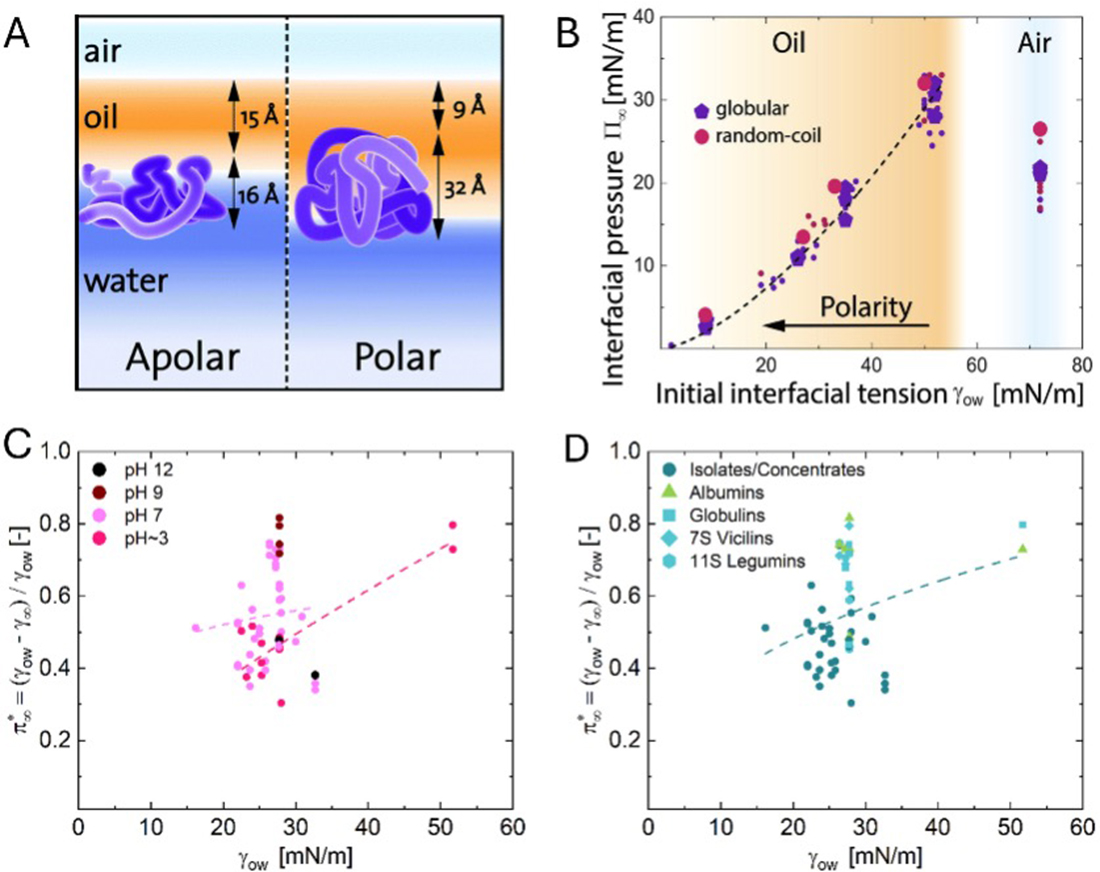
- A) Protein spreading at hydrophobic oil and immersion into polar oils determined by neutron reflectometry.1
- B) Interface tension reduction (interface pressure) as a function oil polarity (initial γow) for common animal proteins extracted from literature with power-law fit.2
C/D) Plotting of plant protein literature data (normalized interface tension) as a function of oil polarity to rapidly obtain an overview of the current data landscape and reveal effects of pH (C) and individual pea protein fractions (D).
(1) Bergfreund, J., Bertsch, P., & Fischer, P. Journal of Colloid and Interface Science 2021, 584, 411–417
(2) Bergfreund, J.; Diener, M.; Geue, T.; Nussbaum, N.; Kummer, N.; Bertsch, P.; Nyström, G.; Fischer, P. Soft Matter 2021, 17 (6), 1692–1700
(3) Lin, L.-H., Bergfreund, J., Fischer, P., & Bertsch, P. Current Opinion of Colloid and Interface Science, 2025, 77, 101920
Speaker
Pascal Bertsch, pascal.bertsch@unifr.ch - Department of Chemistry & Food Research and Innovation Center, Ch. du Musée 9, 1700 Fribourg, Switzerland
Registration link to Zoom Event
https://ucph-ku.zoom.us/webinar/register/WN_dKOX_lg8QX6qjSeRb4wnkw